Your whole balance sheet, in one place.

Verdemar tracks everything you own and everything you owe: listed shares and funds, private equity, private companies, property and cash, set against your mortgages and loans. It values all of it every night, in the currency you choose.

Designed for UK investors: it holds your ISAs, SIPPs and workplace pensions, and works out what you would keep after tax. Everything else it does works wherever you live.

£12 a month. The first month is free.

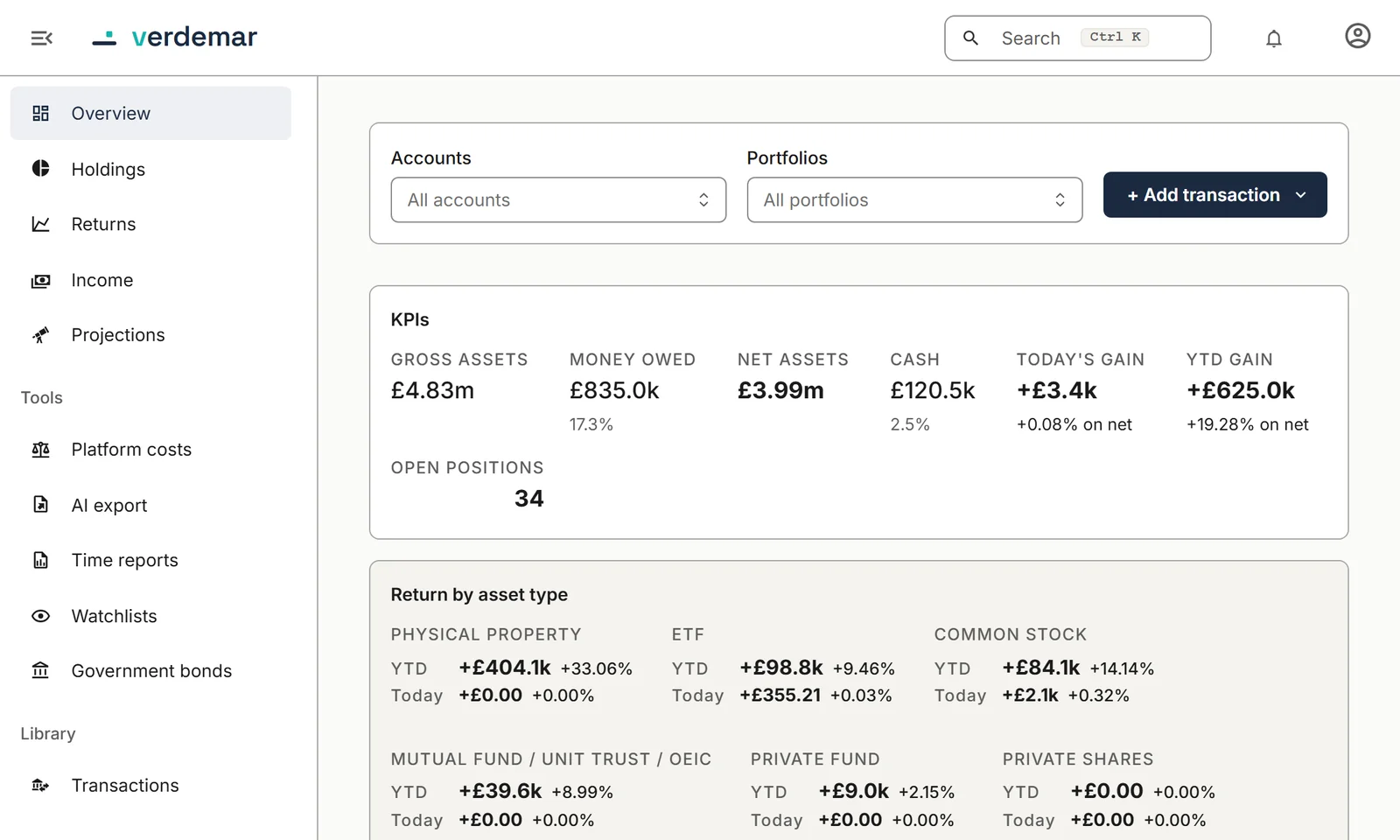
Verdemar's Overview screen: gross assets, money owed and net assets for the whole portfolio, and the return so far this year on each asset type held: property, ETFs, shares, funds, private funds, private shares, cash, gilts and crypto.
A fictional demo portfolio, captured from the app.

What it holds

Private and listed investments, in one place

Shares, ETFs, funds, gilts and crypto sit alongside the holdings most trackers leave out: private equity funds, shares in private companies, and property. Each holding is recorded with the detail it needs.

A private fund carries its commitment, capital called and uncalled, distributions, DPI and TVPI. A property carries its valuations and the rent it earns. A mortgage or loan is held as a liability, builds up interest, and is taken off your net worth.

Held in one place

Listed
Shares ETFs Investment trusts Gilts Bonds Crypto
Funds
OEICs & unit trusts
Private
Private equity funds Private shares
Physical
Property Art & collectibles Precious metals Cash
Owed
Mortgages Loans Margin

What it holds

Wrappers: UK residents

As many accounts and portfolios as you have

An account is where a holding sits: the platform and the wrapper, whether that's an ISA, a Lifetime ISA, a SIPP, a workplace pension or a general account. A portfolio is why you hold it: a core index strategy, an income strategy, the children's money.

Every holding belongs to one of each, so you can follow a strategy spread across three platforms and still see what each platform holds. Verdemar knows how each wrapper is taxed and when you can reach the money.

Accounts: where it sits

  • ISA · Hargreaves Lansdown
  • SIPP · AJ Bell
  • General · Interactive Investor
  • Workplace pension

Unlimited

Portfolios: why you hold it

  • Core index
  • Income
  • Speculative
  • Children

Unlimited

Where you stand

UK residents

Your net position, after tax

The value a platform shows you is gross. Verdemar starts from everything you own, takes off what you owe, and works out how much of the rest you could reach and keep. Each holding is sorted by when you can get to it (now, not until pension age, or not easily at all) and by how it's taxed when you take it out: tax-free, capital gains tax, or income tax. You end with a post-tax figure based on your own tax band.
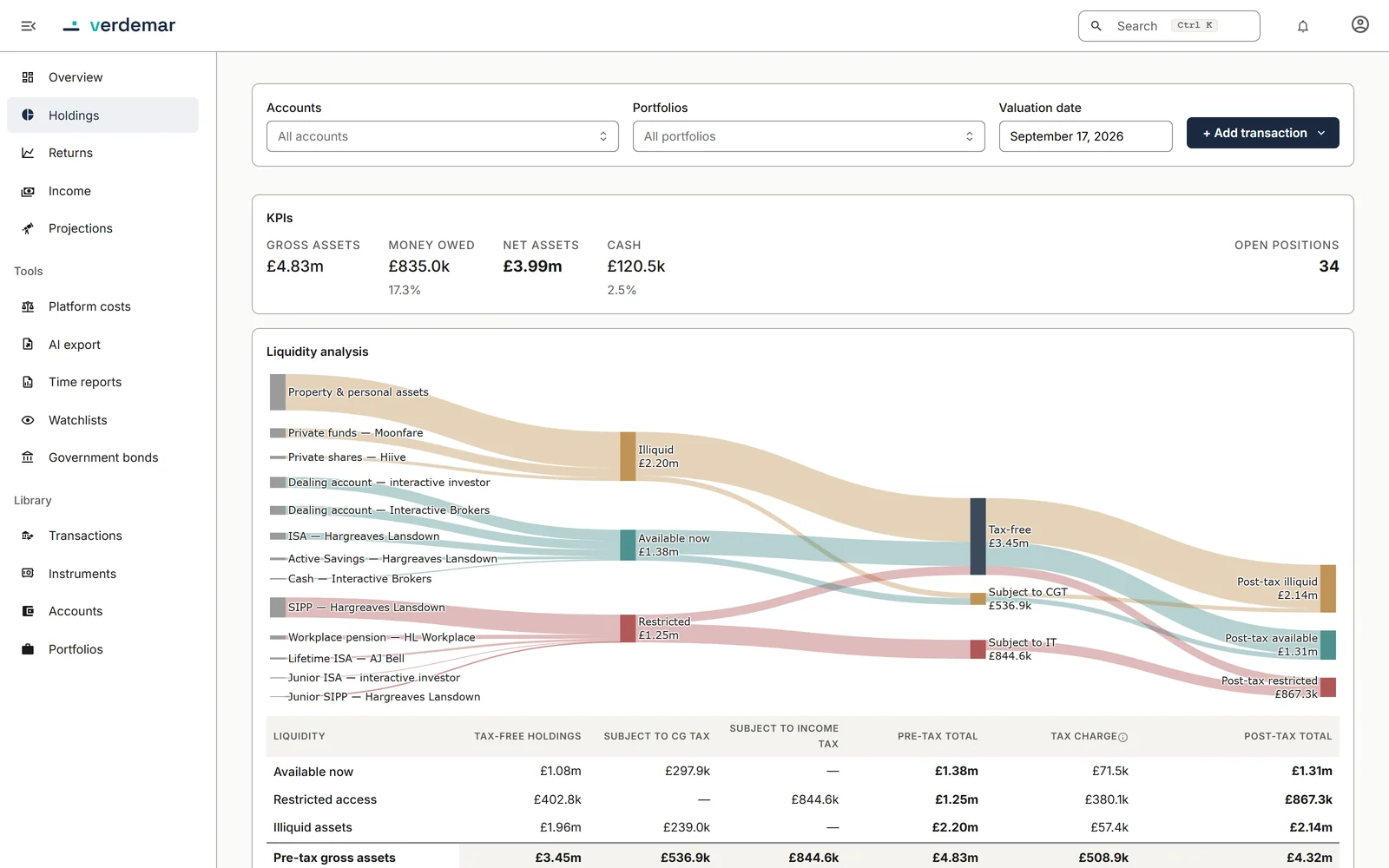
Verdemar's Holdings screen: a flow diagram routing each account through when the money can be reached (available now, restricted or illiquid) and how it would be taxed on withdrawal, ending in post-tax totals, with the same figures in a table beneath.

Swipe the screenshot sideways to read it
Where you stand

Your real exposure, across everything you own

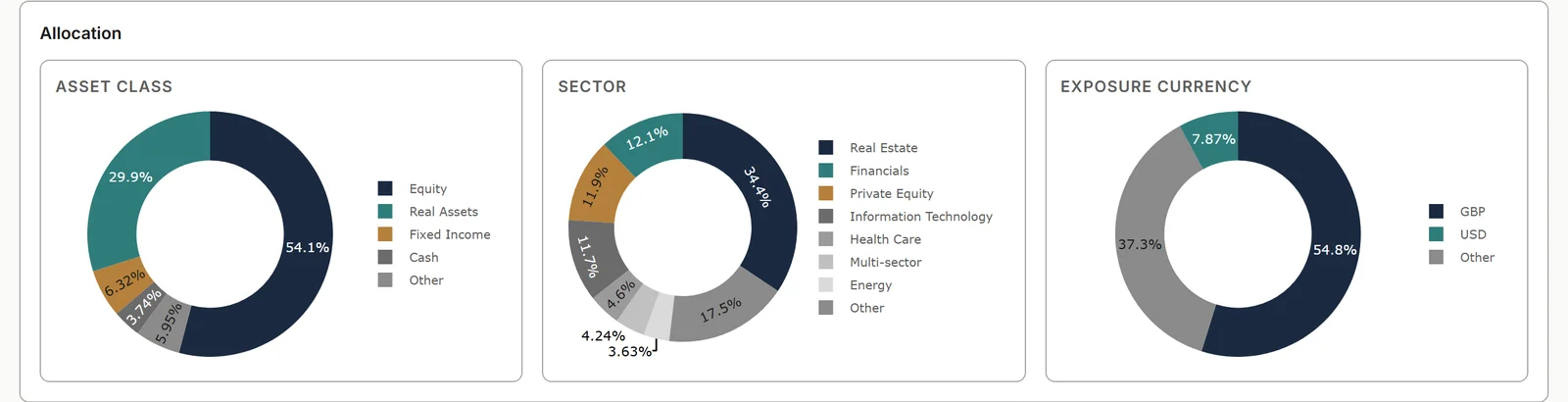
A global index fund isn't one line called "Global". Verdemar looks inside each fund at the regions, sectors and currencies it holds, and adds that to your property, private funds and everything else. You see your actual exposure to the dollar, to technology, or to the UK as a whole. Where a fund's published data runs out, the split is estimated by AI.

Verdemar's Allocation card: three charts splitting the whole portfolio by asset class, by sector and by exposure currency.

Swipe the screenshot sideways to read it
How it has done

A return that reflects when you invested

Verdemar calculates your return as an internal rate of return (IRR), using the actual dates and amounts you put in and took out. Many trackers show a time-weighted return instead. That method deliberately removes the effect of when money went in, which is right for judging a fund manager, who doesn't choose when clients invest. It's wrong for judging your own result, because you did choose.

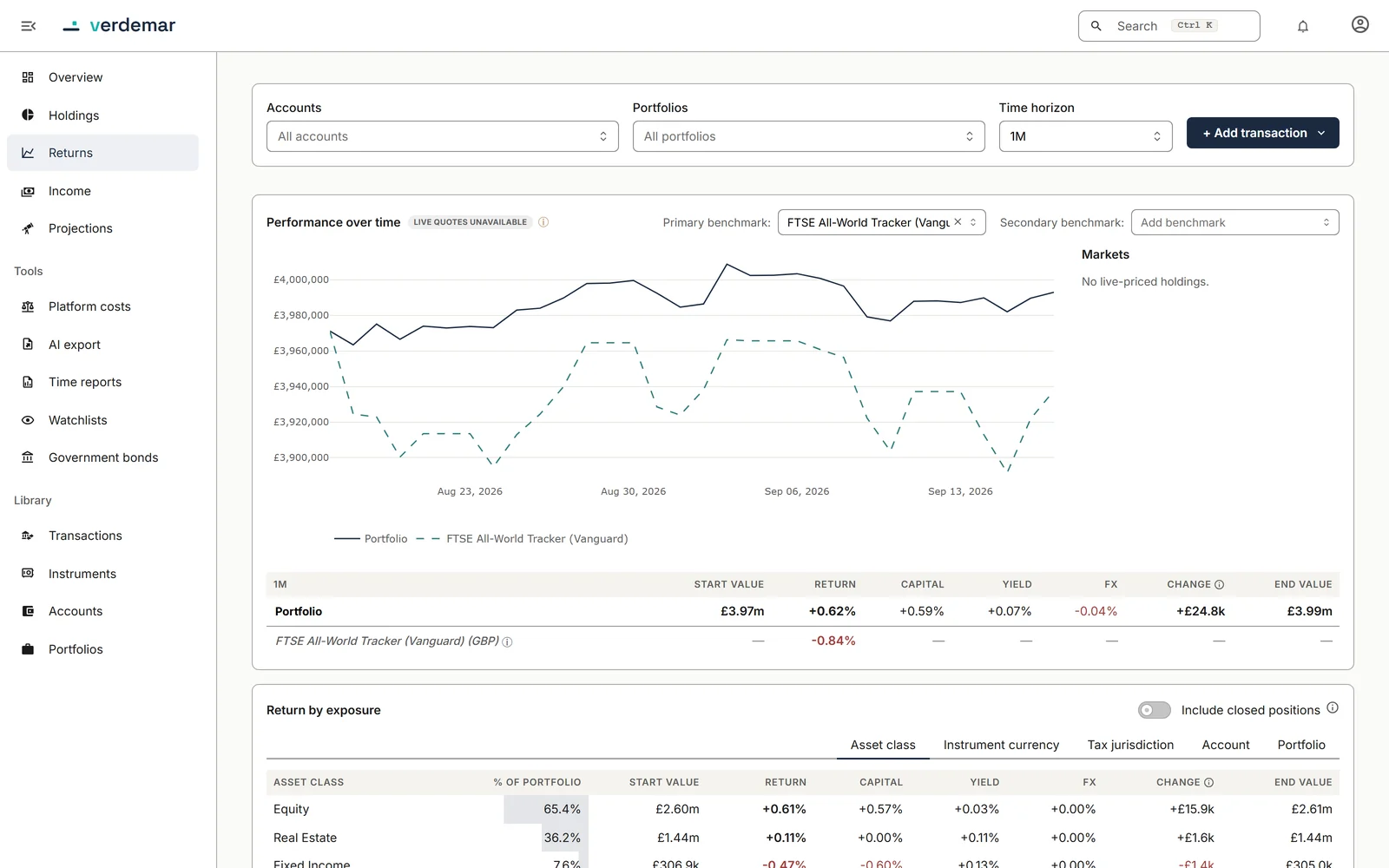
Each return is split into capital growth, income and currency. To benchmark it fairly, Verdemar puts your own contributions, on your own dates, into the index you choose, so you are comparing like with like.

Verdemar's Returns screen: the portfolio's value over time beside a benchmark line, the return split into capital, yield and currency, and returns broken down by asset class.

Swipe the screenshot sideways to read it
How it has done

Reports, sent on a schedule

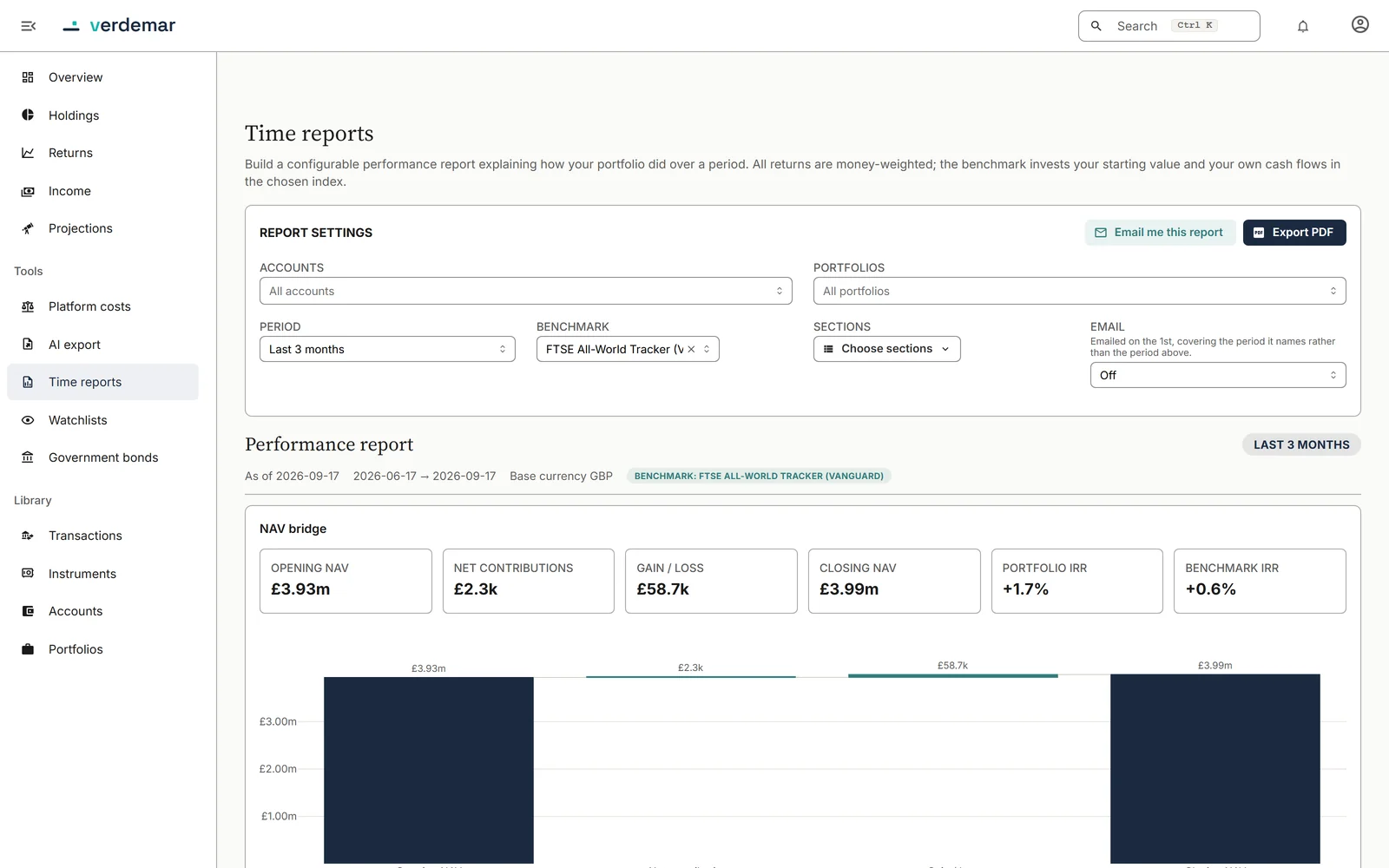
Choose the accounts, the period, the benchmark and the sections you want: performance, what drove it, where your money is invested, how each portfolio did, income. Verdemar builds a report covering everything you own. Download it as a PDF, or have it emailed to you monthly, quarterly or annually.

Verdemar's Time reports screen: settings for accounts, period, benchmark, sections and email schedule, above a bridge from opening value through contributions and gains to closing value, with the portfolio's IRR beside the benchmark's.

Swipe the screenshot sideways to read it
Where it is heading

Tax drag: UK residents

Projections that include the tax

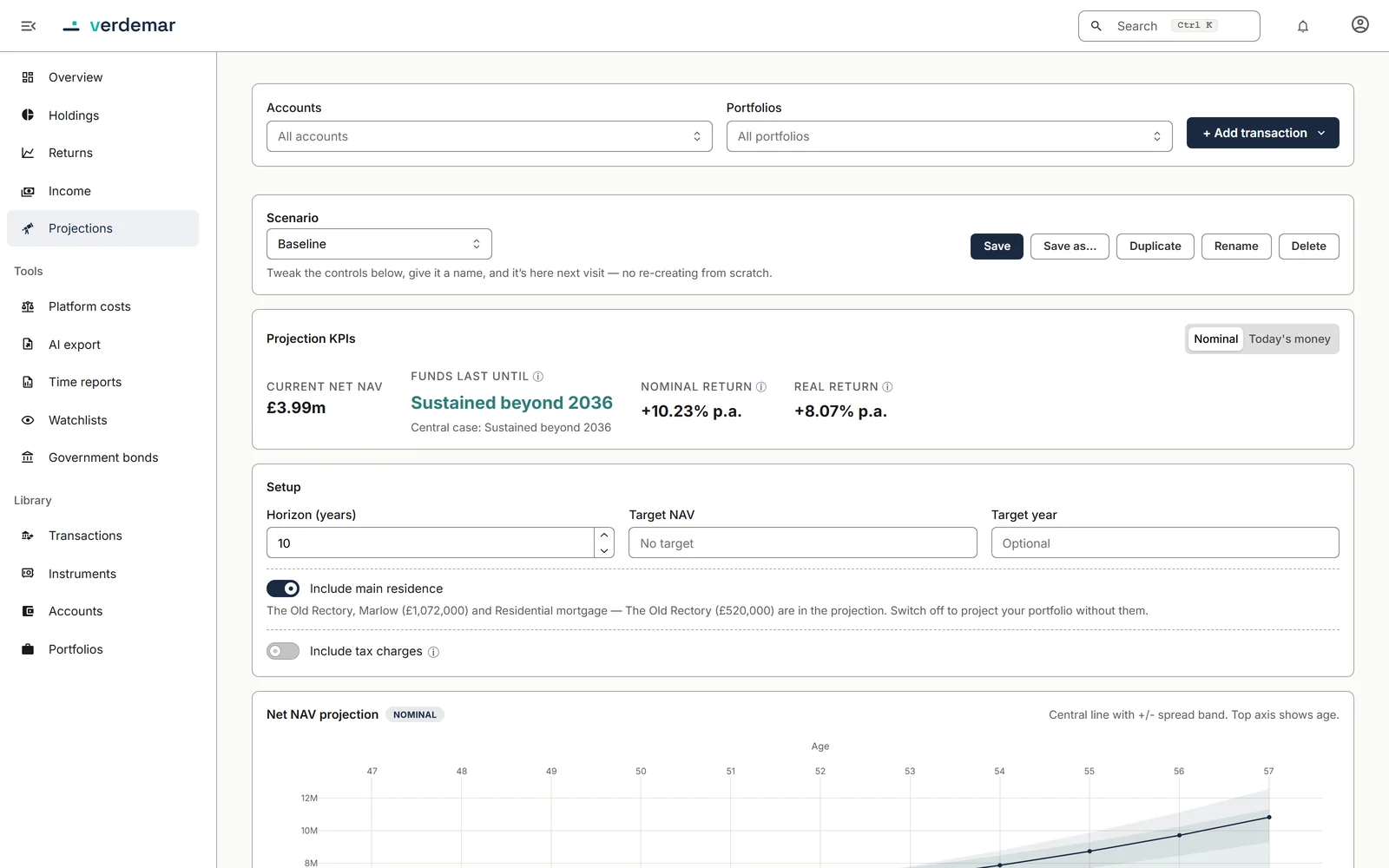
Project your net worth forward under growth and inflation assumptions you set, and save as many named scenarios as you like. Tax on gains and dividends is charged as it falls due, the timeline runs against your age, and you can read the result in today's money. Include or exclude your home and its mortgage, and see the year your money would run out, if it does.

Verdemar's Projections screen: a saved scenario, the year funds last until, nominal and real return, controls for horizon, target, main residence and tax charges, and the start of the net asset projection plotted against age.

Swipe the screenshot sideways to read it
What it costs

UK platforms

What your platforms cost you

Verdemar works out what holding your investments costs you each year, in pounds and as a percentage. It counts platform fees, dealing charges and currency conversion, using your real holdings and your real trading. It then prices the same holdings at each major UK platform, including splitting them across two, which can cost less than any single one.

Taking it elsewhere

A record any AI can read

Everything above is kept as one structured record, and Verdemar can turn it into a brief for ChatGPT, Claude, Gemini or any other AI. The brief covers your holdings, allocation, concentration, tax position, income and returns, written so a model can reason about them rather than misread a raw transaction list. Choose a focus, such as asset allocation, tax efficiency, costs or behavioural biases, and a ready-written prompt comes with it. Account numbers, login details and your transaction history are left out.

Screenshots are of a fictional demo portfolio, captured from the app.

Getting your data in

Your paperwork, read for you

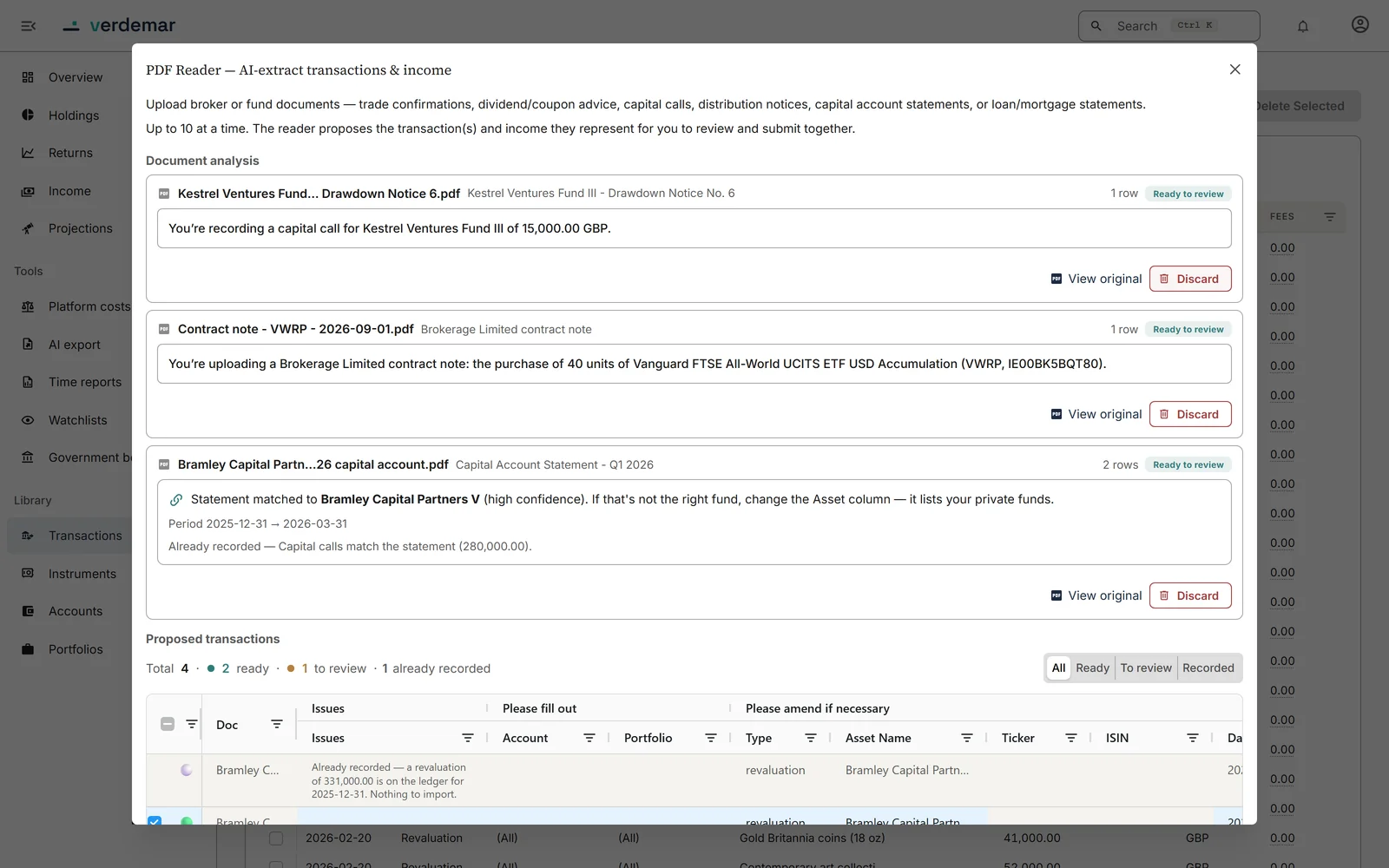
Upload contract notes, capital calls, distribution notices, capital account statements and loan statements, up to ten at a time, and Verdemar's AI document reader turns them into entries for you to approve. It reads scanned documents, checks the printed figures against each other, recognises what you already hold, and reconciles a statement against what you've already recorded instead of adding it twice.

You can also import a CSV or type a transaction in. After that, prices, dividends, gilt coupons, rent and loan interest are added automatically.

Coming soon: email documents straight into Verdemar, and connect the UK brokers that allow it.

Verdemar's AI document reader: one card per uploaded document showing what it was recognised as and what it matched, above a single table of proposed transactions waiting for approval.

Swipe the screenshot sideways to read it

£12 a month, and the first month is free. If you stop paying, you keep read access to everything you've recorded and can export all of it.